
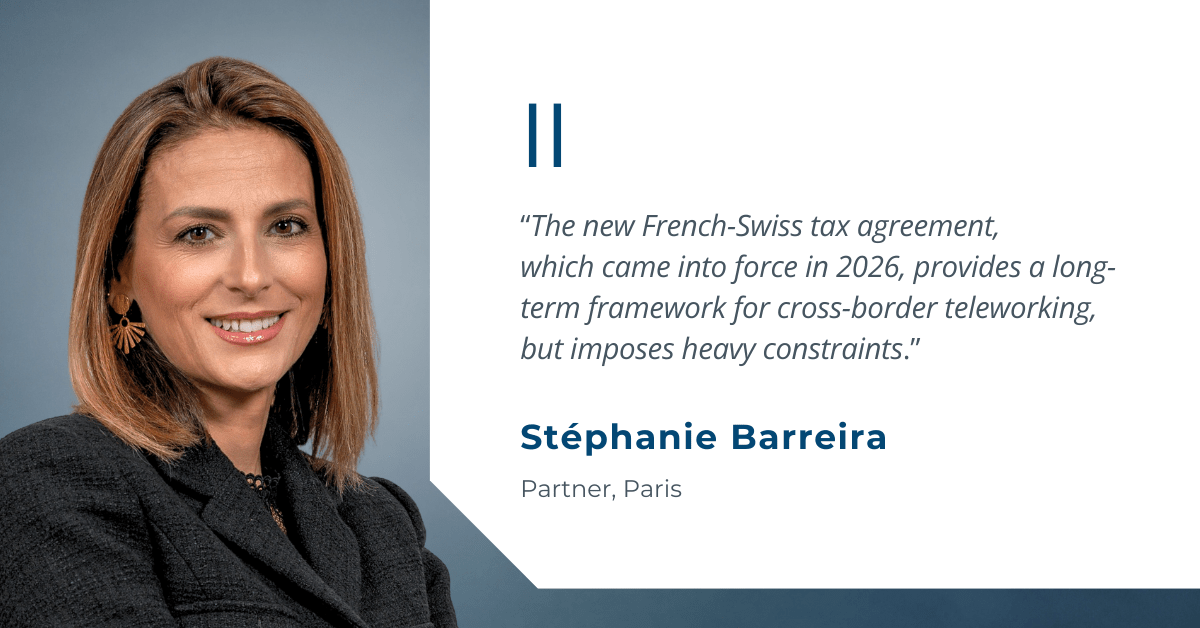
The rise of teleworking has changed the game for tens of thousands of Swiss cross-border workers. Until now, only temporary amicable agreements governed the situation. In December 2023, France and Switzerland signed a permanent addendum to their bilateral tax agreement, specifying the rules for taxing income from cross-border teleworking. This agreement, which came into force on 1st January 2026, establishes a sustainable legal framework while creating new obligations for employers and employees, exposing the latter to unexpected taxation risks in the event of non-compliance.
2026 TAX REGIME: 40% TELEWORKING WITHOUT CHANGE IN TAXATION
The key element of the new tax framework is the threshold of 40% teleworking per calendar year, which determines tax neutrality:
- Up to 40% teleworking from France (based on annual working time), including up to 10 days of temporary assignments (training, business trips), the entire salary remains taxable in Switzerland as if it had been earned at the usual place of work. This “zero tax impact” regime up to 40% had already been in place since 2023 and the long-term agreement confirms it. Switzerland thus retains the right to tax this income in full, avoiding double taxation, but in return pays a lump sum compensation to France for this part of the salary (a purely state mechanism, with no effect on the employee or employer).
- Above 40%, the portion of the salary relating to teleworking days becomes taxable in France from the first day of exceeding this threshold, while remuneration for work performed physically in Switzerland remains taxable in Switzerland. In practical terms, the Swiss employer must adjust the gross salary subject to Swiss withholding tax: the teleworked portion will no longer be included and will be declared in France, while the 40% worked in Switzerland remains subject to Swiss withholding tax.
PRACTICAL RISKS: VIGILANCE REQUIRED
I. Exceeding the 40% threshold
If an employee exceeds the authorised threshold without the employer having anticipated the consequences, several risks may arise:
- Partial transfer of taxation to France, with more complex tax calculations and reporting obligations;
- Potential obligation to register the company in France and implement a withholding tax for teleworked days above the threshold, with significant tax and administrative impacts;
- Enhanced cross-checks between France and Switzerland thanks to the automatic exchange of data from 2027 onwards, exposing the company to adjustments if the information is incomplete or incorrect.
From a corporate tax perspective, an employee working remotely in France does not constitute a permanent establishment for the Swiss company in France (the activity remains attached to the company in Switzerland). On the other hand, an abusive use – for example, central coordination of the company based in France – could theoretically raise the question of a taxable presence beyond the cross-border regime. In practice, complying with the established framework (moderate rate, justification of days) and keeping the main place of activity in Switzerland makes it possible to avoid this risk.
II. Administrative monitoring and reporting
The new cross-border teleworking framework now requires:
- Precise monitoring of teleworking days and temporary assignments carried out from France for each cross-border employee;
- Annual transmission to the Federal Tax Administration (FTA), followed by automatic exchange with the French tax authorities from 2027 onwards.
The absence of a robust traceability system exposes employers to reporting errors, which can result in penalties or adjustments.
III. Interaction with social security rules
Regardless of income tax, teleworking can change social security affiliation rules. As a general rule, cross-border workers are covered by the social security system of their country of employment as long as their teleworking does not exceed 50% of their working time. However, as soon as the proportion of teleworking exceeds 49.9%, the employee automatically switches to the French social security system.
PRACTICAL RECOMMENDATIONS: PLAN AHEAD TO ENSURE COMPLIANCE
To turn this new norm into an organisational advantage rather than a source of risk, employers are encouraged to adopt structured best practices as of now:
I. Implement rigorous monitoring
- Establish a reliable tool for tracking telework days that can be used for annual reporting.
- Make a distinction between teleworking days and temporary assignments in the HR file.
II. Formalise contractual terms
- Insert a cross-border teleworking clause in contracts or via a specific addendum, defining the methodology for calculating the teleworking rate, the obligations of the parties and the consequences of exceeding the 40% threshold.
- Clearly document the conditions for teleworking in internal policies.
III. Raise awareness among HR teams and employees
- Communicate on the issue of the 40% thresholds (taxation) and separate social rules.
- Train HR teams in the management and reporting of teleworking data to avoid data entry and calculation errors that could lead to tax risks.
CONCLUSION: A LEGALLY SETTLED BUT OPERATIONALLY DEMANDING FRAMEWORK
The entry into force of the 2026 tax regime for French-Swiss cross-border teleworkers represents a significant step forward in terms of legal certainty and predictability. The setting of a clear 40% threshold, the introduction of structured reporting and the automatic exchange of data provide a solid foundation.
However, in order to translate this progress into seamless operational compliance, it is essential to adapt internal practices, anticipate reporting obligations and consult qualified experts. These steps not only protect against tax and administrative risks but also enable the new standards to be fully integrated into the company’s HR and international mobility strategy.
Stéphanie Barreira
Partner, Paris